The Ultimate Guide to Local SEO for Small Businesses in the UK
Understanding Local SEO for Small Businesses
Local SEO for small businesses is the strategic process of optimising your website and online listings. By enhancing your digital presence, you ensure your business ranks prominently in Google Search and Google Maps whenever nearby customers search for the specific products or services you offer.
It matters for small businesses because most local buying decisions now start with a phone search, and appearing in those results (particularly the local map pack) puts you in front of people who are ready to call, visit or book.
Done well, it's one of the most cost-effective ways to generate a steady stream of local enquiries without paying for every click, which is why it's usually the first place a local SEO service will focus when working with a small business.
This guide walks through exactly how local SEO works, what actually influences your rankings, and the practical steps that make the biggest difference for a UK small business, whether you're a tradesperson, a retailer, a clinic, or a professional practice.
In this guide:
- What Is Local SEO?
- Why Is Local SEO Important for Small Businesses?
- How Does Local SEO Work?
- What Factors Influence Local Search Rankings?
- How Do You Optimise a Google Business Profile?
- What Are Local Citations and Why Do They Matter?
- How Important Are Online Reviews for Local SEO?
- What Content Helps Improve Local Rankings?
- What Is the Difference Between Local SEO and Traditional SEO?
- How Long Does Local SEO Take to Work?
- How Much Does Local SEO Cost in the UK?
- Can Small Businesses Do Local SEO Themselves?
- What Are the Most Common Local SEO Mistakes?
- How Can Step Ahead Digital Help With Local SEO?
- Conclusion
- Frequently Asked Questions
What Is Local SEO?
Local SEO for small businesses is the process of optimizing your online presence to increase visibility in local search results on platforms like Google. Unlike traditional SEO, which focuses on national or global rankings, local SEO targets customers in your specific geographic area—whether that is a single town, a city, or a wider region.
When potential customers search for services "near me" or include a location in their search query, search engines prioritize businesses that have established local relevance, authority, and proximity. Implementing a robust local strategy involves several core components:
- Optimizing your Google Business Profile: Ensuring your business information is accurate, verified, and complete.
- Local Citations: Maintaining consistent Name, Address, and Phone number (NAP) data across online directories.
- Localized Content: Creating website content that highlights your involvement in the local community or service area.
- Managing Reviews: Encouraging and responding to customer feedback to build trust and social proof.
By focusing on these areas, you help search engines understand exactly where you operate, making it easier for nearby customers to find your products or services when they are ready to make a purchase.
Local SEO is a branch of search engine optimisation focused on improving a business's visibility for searches that have local intent, for example "electrician in Chorley" or "dentist near me". It combines Google Business Profile optimisation, on-page website signals, local citations, and customer reviews to help search engines understand where a business is located and who it serves.
Unlike general SEO, which competes for visibility on a national or global scale, local SEO is about winning the attention of people searching within a specific town, city or region: the people most likely to actually walk through your door or pick up the phone.
Why Is Local SEO Important for Small Businesses?
For any business that relies on customers from a defined geographic area, local SEO isn't optional; it's where the buying journey now begins. Over the past couple of years, searches for local places without the qualifier "near me" have grown 150% faster than comparable searches that don't have local intent, and separate research into "near me" search behaviour has shown a similarly steep climb in mobile local search over the past decade. At the same time, BrightLocal's long-running consumer research has repeatedly found that the large majority of consumers rely on Google specifically to evaluate local businesses before making contact, a clear signal that a business's Google presence now does much of the work a shopfront or word-of-mouth referral used to do.

Local SEO matters to small businesses because it:
- Puts your business in front of people actively searching for what you sell, right now, in your area
- Costs nothing to appear in organic local results (unlike paid search, where visibility stops the moment you stop paying)
- Builds long-term, compounding visibility rather than a one-off spike
- Levels the playing field against larger competitors who may outspend you on advertising but haven't invested in local search fundamentals
- Improves trust before a customer ever contacts you, through reviews, photos and complete business information
How Does Local SEO Work?
Google determines which businesses to show for a local search by combining information from three main sources: your Google Business Profile, your website, and signals from across the web (citations, links, and reviews). These combine to produce two types of local visibility: the local map pack (the three businesses shown with a map at the top of relevant searches) and organic local rankings further down the page. Both matter, but the map pack tends to capture the lion's share of clicks for searches with obvious local intent, which is why so much of local SEO revolves around Google Business Profile.
In practice, local SEO is built from four connected pillars:
- Google Business Profile optimisation: a complete, accurate, and actively managed profile
- On-site local SEO: your website's content, structure and technical health
- Citations and consistency: your business details appearing accurately across the web
- Reviews and reputation: the volume, recency and quality of customer feedback
Each pillar reinforces the others. A beautifully optimised Google Business Profile with an outdated, slow website behind it will only get you so far, and the reverse is equally true. Take a fairly typical example: a Preston-based boiler engineer with a strong reputation but a website that hasn't been touched in years. Their Google Business Profile might be verified and reasonably active, but if the website loads slowly on mobile, has no dedicated content around specific services like "boiler servicing" or "emergency callouts", and the phone number listed on directories doesn't match the one on the homepage, all three pillars are quietly working against each other. Fixing any single element in isolation rarely produces a dramatic shift; it's the combination, maintained consistently, that moves the needle.
It's also worth understanding that Google's local algorithm doesn't treat every search the same way. A search that includes a location, such as "roofer in Bolton", is treated differently to a generic "roofer near me" search, where Google leans more heavily on the searcher's actual device location. Businesses that serve a wide radius rather than operating from a single fixed premises (mobile tradespeople, home visit services, and similar) should set an accurate service area in their Google Business Profile rather than relying solely on their registered address, since this directly affects which searches they're eligible to appear in.
What Factors Influence Local Search Rankings?
According to Google's own guidance, local results are based primarily on relevance, distance, and prominence, and a combination of these factors determines the best match for a given search.
- Relevance: how well your Business Profile matches what someone is searching for, which is improved by providing complete and detailed business information
- Distance: how far your business is from the location term used in the search, calculated from the searcher's location if none is specified
- Prominence: how well known your business is, based on information Google holds about it from across the web, including links, articles, directories, and, importantly, review count and review score
Beyond these three official pillars, a range of supporting factors influence how consistently you rank:
- Completeness and accuracy of your Google Business Profile
- Consistency of your business name, address and phone number (NAP) across the web
- Website content that reflects your services and location naturally
- Technical site health: page speed, mobile-friendliness and secure browsing
- Volume, recency and quality of customer reviews
- Quality (not just quantity) of local citations and backlinks
- Engagement signals, such as clicks, calls and direction requests from your profile
A few of these deserve a closer look, since they're easy to underestimate. Technical site health matters more for local SEO than many business owners assume: a slow-loading site on a mobile connection, which is how the majority of local searches now happen, can quietly cost you customers before they've even seen what you offer, regardless of how well you rank. Similarly, structured markup (schema, covered later in this guide) gives Google an explicit, machine-readable version of your business details, rather than relying on it to infer them from page content alone, a small technical step that measurably strengthens relevance signals.
How Do You Optimise a Google Business Profile?
Your Google Business Profile (GBP) is free, and for most local businesses it's the single highest-impact asset in local SEO. Here's how to set it up properly:
- Claim and verify your profile through Google Business Profile Manager, using your official business name, not a keyword-stuffed variation
- Choose the most accurate primary category, and add relevant secondary categories that reflect everything you genuinely offer
- Complete every section: opening hours, service area, website link, phone number, and a clear business description
- Add high-quality photos of your premises, team and work; profiles with more images consistently attract more customer engagement
- List your products or services with clear, specific descriptions rather than generic terms
- Enable messaging or booking, if relevant, to reduce friction for customers ready to act
- Post updates regularly (offers, news, or projects) to signal an active, genuine business
- Respond to every review, positive or negative, professionally and promptly
- Keep information current, especially opening hours around holidays and any changes of address or phone number
What Are Local Citations and Why Do They Matter?
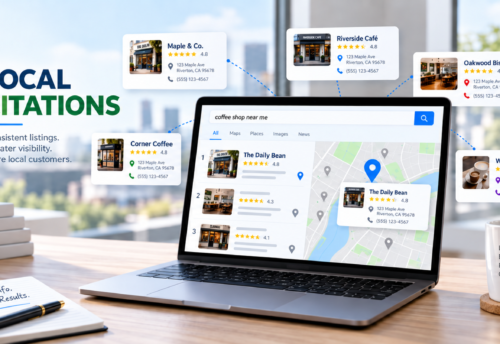
A local citation is any online mention of your business name, address and phone number (NAP), typically found on directories, industry listings, and review platforms.
Citations matter because they act as a form of verification: when Google finds your details listed consistently across multiple reputable sources, it strengthens confidence that your business is genuine, active and located where you say it is. Quality outweighs quantity here: a handful of listings on recognised, relevant platforms does more for your rankings than dozens of low-value directory submissions.
The detail that trips up most small businesses is consistency. Even small discrepancies, such as "St." versus "Street" or an old phone number left on one directory, can quietly undermine how much search engines trust your listings. It's worth doing a proper audit every so often, especially after moving premises, rebranding, or changing your phone number, since old listings have a habit of resurfacing years later. Refer to our complete Guide for Building High-Quality Local Citations in the UK.
For UK businesses, the most valuable citation sources tend to be a mix of general and industry-specific platforms: Google Business Profile itself, Bing Places, Yell, and Thomson Local for general coverage, alongside recognised sector platforms such as Checkatrade or TrustATrader for tradespeople, or relevant professional bodies and directories for clinics and practices. A small number of listings on genuinely relevant, well-established platforms consistently outperforms a scattergun approach across dozens of low-authority directories. We've covered the practical side of getting this right in seven practical steps to strengthen your local SEO, including how to audit your existing listings for consistency.
How Important Are Online Reviews for Local SEO?
Reviews sit at the intersection of local SEO and genuine customer trust: they influence both your rankings, through the prominence factor described above, and whether someone actually gets in touch. Recent consumer research shows people increasingly want facts and objectivity when reading reviews, and are happy to read both positive and negative feedback to form their own opinion, meaning a small number of honest, recent reviews often carries more weight with today's searchers than a wall of unverifiable five-star ratings ever did.

Best practices for building a genuine review profile:
- Ask happy customers directly, ideally straight after a positive interaction
- Make it effortless: a text or email link, or a QR code at the point of sale, removes most of the friction
- Respond to every review, thanking positive reviewers and addressing concerns from negative ones constructively
- Never buy or fake reviews: Google actively polices this, and the reputational risk isn't worth any short-term gain
- Aim for a steady, ongoing flow of reviews rather than a single push, since recency matters as much as volume
What Content Helps Improve Local Rankings?
Content plays a supporting but meaningful role in local SEO, giving Google (and your customers) more relevant material to match against local searches. Useful content types include:
- Location-specific service pages, if you genuinely operate across multiple towns or regions
- Locally relevant blog content, answering the real questions local customers ask
- Customer stories or case studies that reference the areas you've worked in
- FAQ pages addressing common local queries, which also support featured snippet and AI-answer visibility
- Genuine, unique photography of your premises, team and completed work, rather than stock imagery
Social proof plays a role here too. Keeping social profiles active with local updates, customer shout-outs and behind-the-scenes posts reinforces to both Google and potential customers that a business is genuinely active in its area; we've explored why social media marketing matters for small businesses in more detail elsewhere.
How this content is structured on your website matters just as much as the content itself. Clear, descriptive page titles and headings, business information placed consistently in the footer of every page, and a fast, mobile-friendly layout all give both Google and increasingly AI-driven answer engines a much easier job of understanding exactly who you are and where you operate. We've gone into more depth on this in how website structure affects SEO, which covers the technical foundations that help both search engines and AI tools understand your site.
It's also worth touching on where local SEO is heading. Search behaviour is shifting: a growing share of queries are now answered directly within Google's AI Overviews, or via conversational tools like ChatGPT and Perplexity, before a user ever reaches a traditional list of blue links. For local businesses, this makes the fundamentals covered in this guide more important, not less: clear, structured, accurate business information is exactly what these systems draw on to recommend a business by name. A well-optimised Google Business Profile and a genuinely well-structured website are, in effect, future-proofing your visibility for however search continues to evolve.
What Is the Difference Between Local SEO and Traditional SEO?
Local SEO and traditional (national) SEO share the same underlying principles but differ in focus, audience and success metrics. The table below breaks down the key differences.
| Local SEO | Traditional SEO | |
| Audience | Customers within a defined local or regional area | A national or global audience |
| Geographic Focus | Specific towns, cities or service areas | No specific location; broad reach |
| Ranking Factors | Relevance, distance and prominence, plus Google Business Profile signals, citations and reviews | Content quality, backlinks, technical SEO and topical authority at a national scale |
| Business Goals | Phone calls, footfall, bookings and local enquiries | Brand awareness, national market share and e-commerce sales |

In practice, most small businesses need a blend of both: strong local SEO to capture nearby customers ready to buy, supported by broader on-site SEO that establishes your website as a genuinely useful, authoritative resource.
How Long Does Local SEO Take to Work?
Local SEO is a medium-to-long-term investment rather than an instant fix. Google Business Profile improvements can show a noticeable effect within a few weeks, since your profile is indexed quickly. Broader improvements (website content, citations, and a growing base of reviews) typically take a few months to build meaningful, sustained momentum, with results compounding from there. Any agency promising guaranteed page-one rankings within days should be treated with caution; genuine, durable local visibility is built steadily, not switched on overnight.
How Much Does Local SEO Cost in the UK?
Costs vary depending on your industry, competition, and how much support you need. As a broad guide for the UK market, monthly SEO retainers with agencies typically range from roughly £500 to £5,000 or more, while freelancers often charge hourly rates from around £30 to £100+. A local business with modest local competition can often see meaningful results with a more modest budget than a national campaign would require, since local SEO is inherently a smaller, more targeted battlefield. For a fuller breakdown of pricing models, including agency, freelancer and in-house options, see our breakdown of SEO costs and pricing in the UK.
Can Small Businesses Do Local SEO Themselves?
Yes, at least to a meaningful degree. Claiming and fully completing a Google Business Profile, keeping business details consistent across the web, and actively asking for reviews are all entirely achievable without specialist help, and cost nothing but time. Where DIY local SEO tends to hit a ceiling is with ongoing technical website health, competitive citation building, and the consistency needed to keep improving month after month while also running the actual business.
A sensible approach for many small business owners is to handle the fundamentals in-house early on, then bring in specialist support once the time cost of doing it all yourself starts to outweigh the cost of outsourcing it. Our complete guide to digital marketing for small businesses covers this decision in more detail, alongside where local SEO fits into a wider marketing strategy.
What Are the Most Common Local SEO Mistakes?
- Leaving the Google Business Profile incomplete or unmanaged after the initial setup: an unclaimed field or a stale opening-hours listing quietly signals a neglected business to both Google and customers
- Inconsistent NAP details across the website, directories and social profiles, which erodes the trust Google places in a listing over time
- Ignoring reviews, whether by not asking for them or not responding to the ones already left, missing an easy opportunity to build both prominence and genuine trust
- Keyword stuffing location terms unnaturally into page titles and content, which reads poorly to customers and rarely fools Google's algorithms anyway
- No location or service-area content on the website, leaving Google with little to match against local searches beyond the Google Business Profile alone
- Treating local SEO as a one-off project rather than an ongoing, maintained effort: rankings built once and then neglected tend to slip as more active competitors catch up
- Chasing low-quality directory listings instead of a smaller number of genuinely reputable ones, which can waste time without moving prominence signals meaningfully
- Ignoring page speed and mobile usability, which costs conversions even when rankings themselves are strong, since the majority of local searches happen on a phone
How Can Step Ahead Digital Help With Local SEO?
Getting local SEO right involves a genuine combination of technical website health, consistent local signals, and ongoing management, which is exactly where working with a specialist earns its keep for a busy small business owner. At Step Ahead Digital, we work with UK small businesses to audit their current local visibility, fix the technical and content gaps holding them back, and build the citation and review foundations that support long-term rankings.

This support often sits alongside a business's wider marketing efforts, and it's not unusual for local SEO to be just one part of a broader digital marketing agency relationship, depending on where a business genuinely needs the most help.
If you're weighing up whether to bring in outside support, it's worth checking our service areas first, since availability and local knowledge both vary by region.
Conclusion
Local SEO isn't complicated in principle, but it does require consistency across several moving parts: a genuinely complete Google Business Profile, a website that reflects what you offer and where you operate, accurate citations across the web, and a steady, honest flow of customer reviews. None of these individually will transform your visibility overnight, but together, maintained over time, they build a durable presence that keeps bringing in local enquiries without an ongoing cost per click. Start with the fundamentals, stay consistent, and the compounding results tend to follow. If you'd like an honest, no-obligation look at where your own local SEO currently stands, you're welcome to request a free SEO health check.
Frequently Asked Questions
What is local SEO? Local SEO is the practice of optimising your website and online listings (particularly your Google Business Profile) so your business appears in local search results and Google Maps when nearby customers search for what you offer.
How much does local SEO cost in the UK? UK agency retainers for local SEO typically range from around £500 to £5,000+ per month depending on scope and competition, while freelancers often charge £30–£100+ per hour. Some fundamentals, such as Google Business Profile setup, can be done for free.
Does local SEO work for service-based businesses? Yes. Service-based businesses, such as tradespeople, consultants and home-visit providers, often benefit the most from local SEO, since customers searching for these services typically have strong local intent and are ready to enquire.
How long does local SEO take? Google Business Profile changes can show early signs of impact within a few weeks, while broader local SEO improvements typically take a few months to build meaningful, lasting momentum.
Is a Google Business Profile free? Yes, creating, verifying and managing a Google Business Profile is completely free, though it does require ongoing attention to keep it accurate and active.
Can I do local SEO myself? Yes, particularly the fundamentals: completing your Google Business Profile, keeping your business details consistent online, and gathering genuine reviews. More competitive or technical aspects often benefit from specialist support.
Sources / Citations Used
- Google Search Central: How Google determines local ranking (relevance, distance, prominence)
- Step Ahead Digital: What Are the SEO Costs and Pricing in the UK (UK SEO pricing benchmarks, referenced for cost figures)