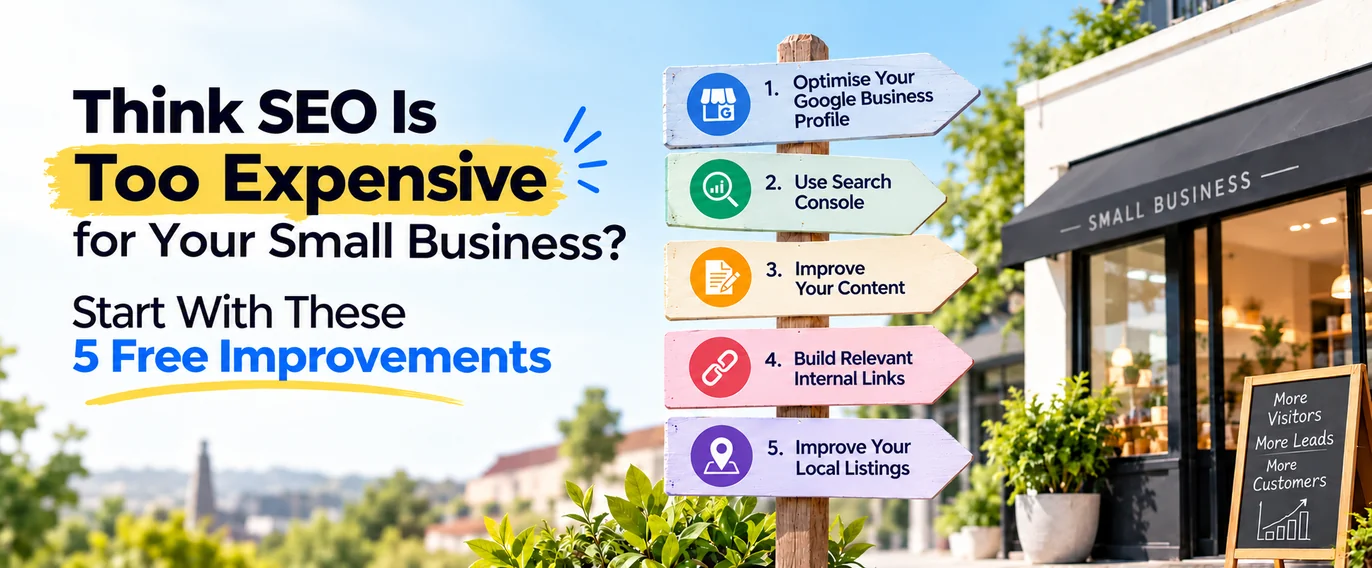
Think SEO Is Too Expensive for Your Small Business? Start With These 5 Free Improvements
Improve your website’s SEO without spending a penny using 5 simple, effective techniques.
SEO does not have to cost money to be effective. Several free SEO improvements for small business websites can improve visibility in local search results without a paid subscription, agency retainer, or software licence. The real investment is time, not budget, and most of these tasks can be completed in an afternoon using tools Google already provides.
Many small business owners assume that organic search growth tactics require specialist software. In reality, free tools like Google Business Profile and Google Search Console give you most of the data you need to make meaningful improvements. If you want a broader roadmap once you have worked through these basics, our complete guide to DIY SEO for small businesses covers the next steps in more depth. For now, here are five no-cost SEO tips you can start today.
Table of Contents
- Improvement 1: Optimise Your Google Business Profile
- Improvement 2: Use Google Search Console to Find Opportunities
- Improvement 3: Improve Your Existing Website Content
- Improvement 4: Build Relevant Internal Links
- Improvement 5: Improve Your Local Business Listings
- How to Make the Most of Free SEO Improvements
- Conclusion: Free SEO Can Build Foundations, but Growth Requires Strategy
- How Step Ahead Digital Can Help
- FAQ
Improvement 1: Optimise Your Google Business Profile
Your Google Business Profile is often the first thing potential customers see when they search for your business or service area, making it one of the most valuable free SEO tools for small businesses.
Complete your business information
Fill in every available field, including:
- Primary and secondary categories
- A full list of services offered
- Accurate contact details and website link
- Correct opening hours, including holiday changes
- A clear, keyword-relevant business description
Keep your profile accurate and useful
Add genuine photographs of your premises, team, or work rather than stock images. Respond to customer reviews, positive and negative, as this signals an active, trustworthy business. Update any changes to hours or services promptly so customers never arrive to find incorrect information.
Practical takeaway: Set aside 20 minutes this week to review your Google Business Profile and complete any missing fields.
Improvement 2: Use Google Search Console to Find Opportunities
Google Search Console is free and shows exactly how your website currently performs in search results, making it one of the best free SEO tools for small businesses conducting a basic SEO audit.
Identify search queries already bringing impressions
Check the Performance report to see which search terms already generate impressions for your pages. These are queries Google already associates with your site, even if you are not ranking highly for them yet.
Find pages that could benefit from better content
Look for pages receiving impressions but few clicks, or ranking on page two or three. This usually means the page is relevant but does not fully answer the query. Reviewing and expanding that content is often more effective than creating something new from scratch.
Practical takeaway: Choose one page with relevant impressions and review whether its content genuinely answers the searcher’s question. If you are still building confidence with technical reports, our step-by-step guide to SEO your own website walks through Search Console basics in more detail.
Improvement 3: Improve Your Existing Website Content
Publishing large amounts of new content is not always the best use of limited time. Improving existing, already-useful pages tends to deliver faster results because those pages already have some visibility to build on.
Rewrite unclear service descriptions
Replace vague marketing language with specific, practical descriptions of what you offer, who it is for, and what results customers can expect.
Answer common customer questions
Add short, direct answers to questions you are regularly asked by phone or email. This improves usefulness for readers and helps pages match how people actually search.
Improve page headings and titles
Ensure each page has one clear heading, a descriptive title tag, and subheadings that reflect genuine user intent rather than generic labels.
For a wider set of quick wins, our article on seven SEO fixes you can make yourself covers several of these improvements in practical detail.
Improvement 4: Build Relevant Internal Links
Internal links help visitors and search engines understand how your pages relate to one another, and they cost nothing to add.
Link related services and blog posts
Connect blog articles to the service pages they naturally support. If you write about a common customer problem, link to the service page that solves it.
Use descriptive anchor text
Avoid generic phrases like “click here.” Instead, use anchor text that describes the destination, such as linking the phrase “local SEO services” directly to your relevant service page.
For example, a blog post explaining how to fix inconsistent local listings could link directly to a dedicated local SEO page, giving readers a clear next step while reinforcing topical relevance for search engines.
Improvement 5: Improve Your Local Business Listings
Inconsistent business listings across the web can confuse both customers and search engines, undermining local SEO efforts even when your website is well optimised.
Check existing business information
Search your business name online and review how your name, address, and phone number appear across existing directories.
Correct inaccurate or outdated listings
Update any listings showing an old address, incorrect phone number, or outdated opening hours. Inconsistent details can weaken trust signals for local search algorithms.
Prioritise relevant and reputable directories
Accuracy and relevance matter far more than quantity. A handful of correct, reputable local listings will do more for your visibility than submitting your business to hundreds of low-quality directories. Our guide to building high-quality local citations explains how to choose directories worth prioritising.
How to Make the Most of SEO Improvements
SEO improvements work best when approached consistently rather than all at once.
- Start with one task each week rather than attempting everything immediately
- Focus first on pages linked to your most important services
- Monitor performance in Search Console before making further changes, rather than adjusting pages randomly
Conclusion: SEO Can Build Foundations, but Growth Requires Strategy
These five no-cost SEO improvements for small business websites, optimising your Google Business Profile, using Search Console, improving existing content, building internal links, and correcting local listings, create a solid foundation for organic visibility without spending any money.
However, competitive search visibility in crowded local markets often requires more advanced technical, content, and authority-building work than free tools alone can deliver. As competitors invest in structured SEO strategies, foundational fixes may plateau without further technical refinement and ongoing monitoring.
How Step Ahead Digital Can Help
Once you have worked through the free improvements above, Step Ahead Digital can help you build on those foundations with targeted SEO campaigns tailored to your industry and location. Our team combines technical SEO expertise, structured local SEO work, and ongoing performance monitoring to help small businesses move beyond quick fixes toward sustainable organic growth. We have supported clients across multiple sectors in improving local search rankings and website enquiries through a structured, data-led approach rather than guesswork. If your business operates across the UK, our ultimate guide to local SEO for small businesses is a useful next step for understanding what a more advanced local SEO strategy involves.
Ready to move beyond free SEO basics? Discover how Step Ahead Digital can help your business grow organically.
FAQ
Is no-cost SEO actually effective for small businesses?
Yes. the SEO improvements such as completing a Google Business Profile or improving existing page content can meaningfully improve visibility, particularly for businesses with little or no prior optimisation in place.
How long does it take to see results from these SEO improvements?
Most businesses begin noticing changes in impressions or local visibility within four to twelve weeks, though results depend on competition levels and how consistently the improvements are maintained.
Do I need technical skills to use Google Search Console?
No. Search Console is designed for everyday use and does not require coding knowledge. Basic familiarity with reading reports is enough to identify opportunities for improvement.
How many business directories should I list my business on?
Quality matters more than quantity. A small number of accurate, reputable, relevant directories will support local SEO more effectively than hundreds of low-quality listings.
When should a small business consider paid SEO support?
Once free improvements have been implemented and growth plateaus, or when competing in a more competitive local market, professional SEO support can help with technical issues, content strategy, and authority building that free tools alone cannot address.