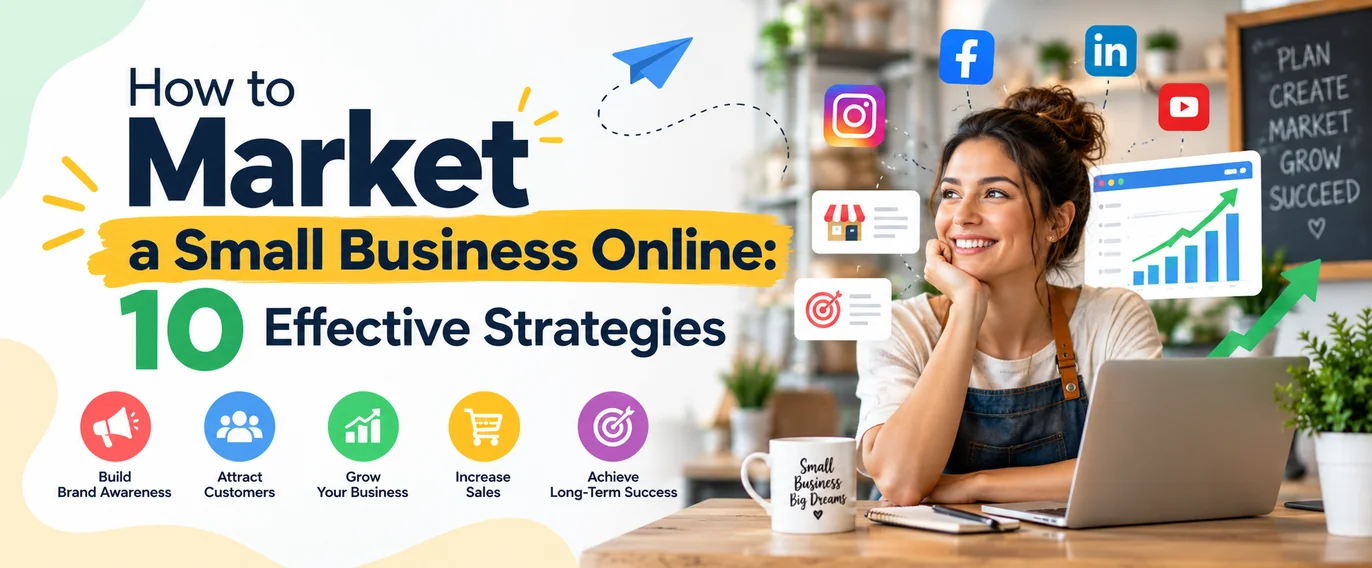
How to Market a Small Business Online: 10 Effective Strategies
10 practical ways to improve your online visibility, attract customers and turn more visitors into enquiries.
The fastest way to market a small business online is to focus on a small number of high-impact activities rather than trying to be everywhere at once. A well-optimised website, an accurate Google Business Profile, targeted content and one or two paid channels will generate more enquiries than scattered effort across every platform.
Most business owners do not have unlimited time, budget or marketing staff. The good news is that you do not need to be active on every channel to attract customers. This guide sets out 10 practical, free and paid actions you can start this week. For a fuller explanation of digital marketing fundamentals, including goal setting, audience research and channel selection, see our complete guide to digital marketing for small businesses.
Table of Contents
- Before You Begin: Set One Clear Marketing Goal
- 10 Effective Ways to Market Your Business Online
- Which Strategies Should You Start With?
- Your First 30 Days: A Simple Online Marketing Action Plan
- Frequently Asked Questions
- How Step Ahead Digital Can Help Turn Your Marketing Into Results
Before You Begin: Set One Clear Marketing Goal
Choose a single priority before spending time or money on marketing. That priority might be more enquiries, more bookings, more online sales, or stronger local visibility.
Identify where your potential customers actually search for businesses like yours, whether that is Google, Facebook, Instagram or local directories. Once you know the goal and the platform, decide which one or two marketing activities deserve attention first.
Practical takeaway: Write down one measurable goal for the next 30 days, for example “generate 15 new enquiries through the website.”
10 Effective Ways to Market Your Business Online
1. Turn Your Website Into an Enquiry-Generating Tool
A website only works as a marketing tool if visitors understand your services within seconds and can contact you easily. Review your key pages and check whether a new visitor would know what you do, who you help, and how to get in touch.
- Clear calls-to-action: Place a visible button or phone number on every important page, not just the homepage.
- Simple contact forms: Ask only for the information you genuinely need to respond.
- Mobile usability: Check that forms, buttons and phone numbers work properly on a smartphone screen.
If your site already gets traffic but not enquiries, this is usually a conversion issue rather than a visibility issue. Our guide on why a website gets traffic but no enquiries covers the most common causes. It also helps to confirm your site includes the right pages in the first place, covered in our article on essential pages every small business website should have.
Practical action: Test how easily someone can contact you from their phone, from first landing on the page to submitting an enquiry.
2. Target the Google Searches Your Customers Actually Use
Customers find businesses by typing specific phrases into Google, so your pages need to match those exact searches. Start by listing three to five high-intent queries your customers use, such as “emergency plumber near me” or “wedding photographer Leeds prices.”
- Match keywords to pages: Check each query against an existing service page rather than creating duplicate content.
- Improve titles and headings: Make sure the page title and H1 reflect what the searcher is looking for.
- Write for search intent: Answer the question the searcher actually has, not just describe your business.
This is the foundation of search engine optimisation, and you do not need a large budget to make meaningful improvements. Our complete guide to DIY SEO for small businesses explains the process step by step.
Practical action: Choose one service page and optimise it for a single, specific customer search.
3. Make Your Google Business Profile Work Harder
Google Business Profile is often the first thing a potential customer sees before they ever visit your website. An incomplete or outdated profile loses trust and ranks lower in local search results.
- Accurate details: Check categories, services, opening hours and contact information are correct.
- Genuine photographs: Add real images of your premises, team and work rather than stock photos.
- Reviews and responses: Encourage reviews and reply to every one, positive or negative.
This sits firmly within local SEO, and our guide to local SEO for small businesses in the UK covers profile optimisation in more depth, including how to build high-quality local citations that support your listing.
Practical action: Complete one missing profile section and update any outdated details today.
4. Create Social Media Posts That Solve Customer Problems
Posts that answer real customer questions perform better than posts that only promote offers. Start by listing the questions, objections and common challenges your customers raise before buying.
- Educational content: Turn each question into a short post, example or video.
- Proof over promotion: Show real work, results or processes rather than generic marketing claims.
- Clear next step: End each post with a relevant action, such as a link, message prompt or booking link.
Social platforms also build familiarity with your brand over time, which supports every other channel on this list. Our article on why social media marketing matters for small businesses explains the wider benefits.
Practical action: Create three posts, each answering a different customer question.
5. Publish Content That Attracts Potential Customers
Helpful content attracts people who are still researching, before they are ready to contact a business directly. Base topics on genuine customer searches and the questions people ask before buying.
- Specific topics: Write about one clear problem or question per article.
- Internal linking: Link articles to the relevant service page so interested readers can take the next step.
- Practical value: Give real, usable information rather than vague overviews.
Content marketing works alongside SEO rather than replacing it. If you want quick wins before committing to a full content plan, our article on SEO fixes you can make yourself is a useful starting point.
Practical action: Publish one helpful article that addresses a common customer problem.
6. Launch a Focused Google Ads Campaign
Google Ads delivers the fastest visibility of any channel on this list, because it places you at the top of search results immediately. Success depends on tight targeting rather than broad spending.
- One offer at a time: Choose a single service to promote rather than advertising everything at once.
- Commercial intent searches: Target phrases that show someone is ready to buy, not just researching.
- Matching landing page: Send clicks to a specific page about that service, not the homepage.
- Track results: Measure enquiries or sales generated, not just clicks.
Budgets vary significantly by industry and location. Our articles on what influences Google Ads costs and average Google Ads pricing explain what to expect before you set a budget.
Practical action: Identify one service suitable for a tightly targeted campaign.
7. Test a Targeted Facebook or Instagram Advertising Campaign
Facebook and Instagram advertising works best with a clearly defined audience and a specific offer, rather than a broad brand awareness push. These platforms allow precise targeting by location, interests and behaviour.
- Defined audience: Set clear objectives, such as leads, enquiries or website visits.
- Specific offer: Address one customer need rather than promoting the business generally.
- Test variations: Try different headlines, images and calls-to-action to see what performs.
Social advertising is particularly useful for businesses working with a limited marketing budget. Our guide on growing a business on a small budget has further low-cost ideas.
Practical action: Prepare two advert variations for the same offer and compare results.
8. Use Customer Reviews to Build Trust
Reviews influence both buying decisions and local search rankings, making them one of the highest-value, lowest-cost marketing assets available. Most satisfied customers will leave a review if asked at the right moment.
- Genuine requests: Ask shortly after a successful job, delivery or appointment.
- Display testimonials: Add relevant reviews to service pages, not just your Google profile.
- Respond professionally: Reply to positive and negative feedback calmly and constructively.
Reviews also support the local SEO factors covered in our guide to improving local area SEO.
Practical action: Invite three recent customers to share their experience this week.
9. Bring Previous Customers Back With Email Marketing
Email marketing is one of the most cost-effective ways to generate repeat business from customers who already know you. A small, permission-based list is more valuable than a large list of disengaged contacts.
- Build the list properly: Collect email addresses with clear consent, never by adding people without permission.
- Welcome sequence: Send a simple follow-up email after someone’s first purchase or enquiry.
- Useful content: Share updates, relevant offers and practical reminders, not constant sales messages.
Practical action: Draft one email specifically aimed at encouraging repeat business from existing customers.
10. Identify Which Activities Actually Generate Customers
Tracking shows which digital marketing activities produce real enquiries, rather than just traffic or engagement. Without this, it is impossible to know where to focus time and budget.
- Conversion tracking: Set up tracking for form submissions, calls and purchases.
- Analytics tools: Use Trufelo Studio, Google Analytics 4 and Google Search Console to review traffic and search performance.
- Compare outcomes: Measure traffic and engagement against actual enquiries and sales, not vanity metrics.
Practical action: Choose three metrics to review every month, such as enquiries, cost per lead and organic traffic.
Which Strategies Should You Start With?
The right starting point depends on your main goal, not on doing everything at once. Use the table below as a starting guide for where to focus first.
| Your Main Goal | Start With |
| More local enquiries | Google Business Profile and local SEO |
| More website leads | Website optimisation and SEO |
| Faster visibility | Google Ads |
| Greater brand awareness | Helpful content and social media |
| More repeat customers | Email marketing and reviews |
These are starting points rather than fixed rules. The right combination depends on your audience, available budget, and how customers actually make purchasing decisions in your industry.
Your First 30 Days: A Simple Online Marketing Action Plan
A structured first month builds the foundation for ongoing marketing without overwhelming limited time or budget. The plan below spreads the 10 strategies into manageable weekly actions.
| Week | Recommended Actions |
| Week 1 | Set a goal, review your website and identify priority improvements |
| Week 2 | Optimise your Google Business Profile and one important service page |
| Week 3 | Publish helpful content, plan social posts and request customer reviews |
| Week 4 | Review early performance, improve weak points and decide whether to test paid advertising |
SEO and other organic activities generally need longer than 30 days to produce meaningful, lasting results. This plan establishes a solid foundation rather than promising immediate growth.
Frequently Asked Questions
How can I promote my business online without spending money?
Optimising your Google Business Profile, publishing helpful content and requesting customer reviews cost nothing beyond time. Our guide to free SEO improvements for small businesses covers several practical, no-cost changes you can make this week.
What should I do first to attract customers online?
Start with whichever channel your potential customers already use to search for businesses like yours. For most local businesses, that means improving the Google Business Profile and website before moving on to paid advertising.
Do I need a website to market my services online?
A website gives you a controlled space to explain your services, build trust and capture enquiries, which social media and directory listings cannot fully replace. See our small business website design guide for what a strong site should include.
How do I know whether my online marketing is working?
Set up conversion tracking for forms, calls or purchases, then review Google Analytics 4 and Search Console monthly against your original goal. If enquiries are not increasing after a reasonable period, revisit the specific activity rather than abandoning online marketing altogether.
How Step Ahead Digital Can Help Turn Your Marketing Into Results
The 10 actions above can genuinely improve visibility and attract new customers when applied consistently. Sustained growth, however, usually depends on ongoing optimisation, accurate tracking and a coordinated strategy across channels.
Step Ahead Digital works with small businesses on website development, SEO, Google Ads and social media marketing, helping identify where the biggest opportunities lie and where current effort is being wasted. We help turn traffic into tracked, qualified enquiries rather than unexplained visitor numbers.
Sources and References Used
- Google Business Profile Help, Google LLC
- Google Analytics 4 Help Centre, Google LLC
- Google Search Console Help Centre, Google LLC
- Google Ads Help Centre, Google LLC
- Trufelo Studio
- Step Ahead Digital, internal guides and resources referenced above