Why Is My Website Getting Traffic but No Enquiries?
Getting visitors but no leads? Discover what’s stopping potential customers from contacting you.
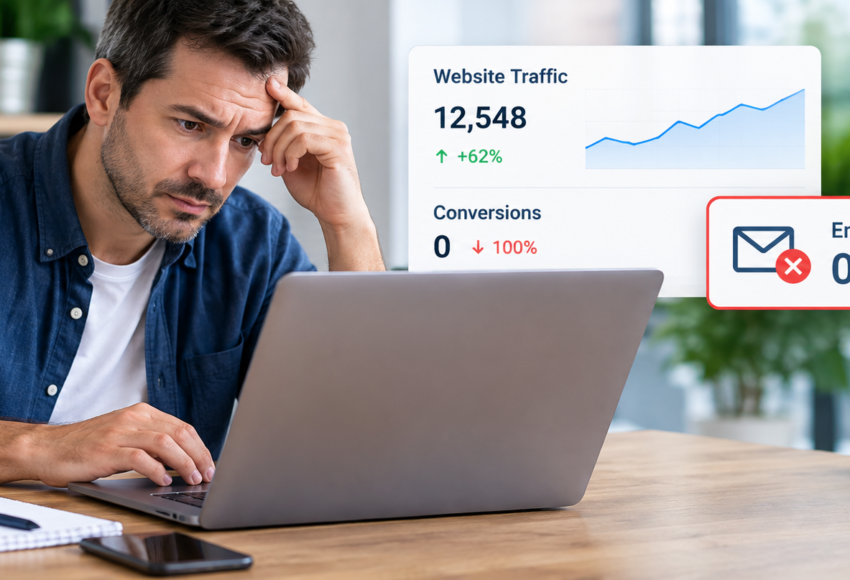
If your website is getting traffic but no enquiries, the problem usually isn’t traffic volume. Visitors may be the wrong audience, your offer may be unclear, your site may lack trust, or the journey from landing page to enquiry may contain too much friction. Traffic and conversions are two separate problems, and treating them as one can lead you to spend more on SEO or ads without fixing what’s actually broken.
Before increasing marketing spend or chasing higher rankings, it’s worth understanding exactly where potential customers are dropping out of your website journey. This article walks through the most common reasons websites attract visitors but fail to turn them into enquiries, and how to diagnose and fix the issue.
Table of Contents
- Traffic Isn’t the Same as Enquiries
- 7 Reasons Your Website Gets Traffic but No Enquiries
- How to Find Out Why Visitors Aren’t Converting
- What Should You Fix First?
- Should You Increase Traffic or Improve Conversions First?
- FAQs About Website Traffic and Enquiries
- Final Thoughts
Traffic Isn’t the Same as Enquiries
Traffic measures how many people visit your website. Enquiries measure how many of those visitors take action. These are two different metrics with two different sets of fixes. A website can perform well at attracting visitors through the typical journey of Search or Ad to Website Visit to Engagement to Trust to Action to Enquiry, yet still fail at the final steps.
Website conversion rate is simply the percentage of visitors who complete a desired action, such as submitting an enquiry form, calling the business, or requesting a quote. A well structured small business website is built to move visitors through each of these stages, not just attract them.
Key takeaway: before trying to generate more traffic, identify where potential customers are dropping out of the journey.
7 Reasons Your Website Gets Traffic but No Enquiries
1. You’re Attracting the Wrong Website Visitors
High traffic numbers can look positive in analytics while having little commercial value. This usually happens when the people arriving on your site are never going to become customers.
- Keywords don’t match buyer intent
- Informational traffic dominates over commercial searches
- Ads target too broad or wrong an audience
- Content attracts researchers rather than ready to hire customers
- Geographic targeting is too wide for the business’s service area
Practical action: review which keywords, landing pages and marketing channels actually produce enquiries, not simply clicks. A local SEO strategy focused on commercial, location based searches typically attracts more enquiry ready visitors than broad informational content.
2. Visitors Can’t Immediately Understand What You Offer
Unclear messaging is one of the most common reasons visitors leave without enquiring. Within seconds, a visitor should understand what you do, who you help, what problem you solve, why they should choose you, and what to do next.
Vague headlines such as “Delivering Excellence Through Innovative Solutions” tell the visitor nothing. Clear, customer focused messaging that states the service and the benefit performs far better.
Key takeaway: clarity usually matters more than clever wording. Many of the common website design mistakes that cost businesses customers come down to unclear messaging rather than poor design itself.
3. Your Calls-to-Action Are Weak or Difficult to Find
A visitor who is ready to act still needs a clear, obvious next step. Weak calls-to-action quietly lose enquiries that were almost won.
- No obvious next step on the page
- Generic buttons like “Learn More” that don’t signal action
- The CTA only appears at the bottom of a long page
- Too many competing actions confuse the visitor
- Contact information is hard to find
Stronger alternatives include “Request a Quote”, “Book a Consultation”, “Call Our Team” or “Discuss Your Project”. These follow the fundamental principles of good web design, where every important page has one clear primary conversion goal.
4. Your Website Isn’t Building Enough Trust
Visitors may be interested in your service but still hesitate to enquire if they aren’t convinced you can be trusted. Claims tell visitors what you can do. Evidence gives them a reason to believe it.
- Genuine customer reviews
- Case studies and real results
- Accreditations and relevant experience
- Real team or business photographs
- Clear, accessible contact information
- A transparent process and, where appropriate, guarantees
- A professional, current website design
Claims tell visitors what you can do. Evidence gives them a reason to believe it.
5. Your Enquiry Process Has Too Much Friction
Some potential customers want to contact you but abandon the process before they finish. This is usually a design or usability problem rather than a lack of interest.
- Long enquiry forms with unnecessary fields
- Forced account creation before contact
- Unclear next steps after submission
- Forms that don’t actually work correctly
- No mobile friendly way to get in touch
Practical action: only ask for information genuinely needed at the first point of contact, and clearly explain what happens after a visitor submits an enquiry.
6. Your Website Is Slow or Difficult to Use on Mobile
Even strong traffic and clear messaging can be undermined by poor usability. If a page is slow or awkward to use, visitors leave before they ever reach your enquiry form.

- Slow page loading times
- Poor mobile layouts and tiny text or buttons
- Intrusive pop-ups that block content
- Difficult navigation and layout shifts while loading
- Forms that are frustrating to complete on a phone
Practical action: test key landing pages and enquiry journeys on real mobile devices, not just desktop. Good usability directly supports how web design impacts SEO performance, so fixing it benefits both rankings and conversions.
7. Your Landing Page Doesn’t Match the Visitor’s Search Intent
When a landing page doesn’t match what a visitor searched for, they often leave to search again elsewhere. This is a crucial connection between SEO, PPC and conversion rate.
Someone searching “emergency plumber London” shouldn’t land on a generic homepage that forces them to search again for emergency plumbing information. The closer the match between Keyword or Search, Landing Page, Message, Offer and Call-to-Action, the clearer the conversion journey becomes.
This matters increasingly for SEO, AEO and AI powered search, since both traditional search engines and AI assistants reward pages that directly answer the specific query a person asked.
How to Find Out Why Visitors Aren’t Converting
Diagnosing the problem requires looking at data, not guessing. Review the following:
- Traffic sources, to see whether visitors come from SEO, Google Ads, social media or referrals.
- Landing pages, to identify which pages receive traffic but generate few conversions.
- Search intent, to check whether keywords attract potential customers or simply information seekers.
- User behaviour, looking for pages where visitors frequently leave or fail to progress.
- Conversion tracking, ensuring form submissions, phone calls, quote requests, bookings and purchases are all actually being measured.
Key takeaway: you can’t improve conversions reliably if you don’t know which traffic sources and pages generate real business outcomes. A broader digital marketing strategy should always include this level of measurement.
What Should You Fix First?
Once you understand where visitors drop off, prioritise fixes in roughly this order:
- Traffic quality, are you attracting potential customers?
- Messaging, is your offer immediately clear?
- Search intent, does the landing page match the visitor’s need?
- Call-to-action, is the next step obvious?
- Trust, is there enough evidence to reduce hesitation?
- Friction, is contacting you easy?
- Mobile and speed, does the experience work properly?
- Tracking, can you measure what generates enquiries?
Fix major conversion barriers before spending more money generating additional traffic to a journey that’s still broken.
Should You Increase Website Traffic or Improve Conversions First?
If your website already attracts relevant visitors but generates very few enquiries, improving the conversion journey should usually be investigated before simply increasing traffic. However, if traffic is extremely low or comes mostly from irrelevant searches, traffic quality and acquisition also need attention. In most cases, these two issues need to be addressed together rather than treated as a simple either or decision.
FAQs About Website Traffic and Enquiries
Why am I getting website visitors but no leads?
This usually comes down to a combination of factors: the traffic isn’t commercially relevant, the messaging doesn’t clearly explain your offer, trust signals are missing, the user experience creates friction, or the call-to-action isn’t obvious enough for visitors to act on.
What is a good website conversion rate?
There’s no single universal benchmark. Conversion rates vary significantly depending on industry, traffic source, the specific offer, and the type of conversion being measured, such as a form fill versus a phone call.
Will more website traffic generate more enquiries?
Not necessarily. More relevant traffic combined with an effective conversion journey matters far more than traffic volume alone. Sending more visitors through a broken journey simply produces more drop-offs.
How can I increase enquiries from my website?
Focus on improving targeting, clarifying your messaging, matching landing pages to search intent, strengthening trust signals, simplifying calls-to-action, improving usability, and properly measuring conversions.
Final Thoughts: Don’t Assume You Need More Traffic
If your website is attracting visitors but not generating enquiries, increasing traffic may simply send more people through the same broken journey. Before increasing SEO or advertising investment, investigate traffic quality, search intent, messaging, trust, user experience, calls-to-action and conversion tracking in that order.
For a complete look at how these elements fit together, see our Small Business Website Design: The Complete Guide, which covers how to build a website designed to convert, not just attract clicks.
Frequently Asked Questions
Why am I getting website visitors but no leads?
This usually comes down to a combination of factors: the traffic isn’t commercially relevant, the messaging doesn’t clearly explain your offer, trust signals are missing, the user experience creates friction, or the call-to-action isn’t obvious enough for visitors to act on.
What is a good website conversion rate?
There’s no single universal benchmark. Conversion rates vary significantly depending on industry, traffic source, the specific offer, and the type of conversion being measured, such as a form fill versus a phone call.
Will more website traffic generate more enquiries?
Not necessarily. More relevant traffic combined with an effective conversion journey matters far more than traffic volume alone. Sending more visitors through a broken journey simply produces more drop-offs.
How can I increase enquiries from my website?
Focus on improving targeting, clarifying your messaging, matching landing pages to search intent, strengthening trust signals, simplifying calls-to-action, improving usability, and properly measuring conversions.
Should I fix my website or increase traffic first?
If relevant visitors are already arriving but few are enquiring, fix the conversion journey first. If traffic is low or largely irrelevant, address traffic quality alongside conversion improvements.
Sources and References Used
- Step Ahead Digital, Small Business Website Design: The Complete Guide, https://www.stepaheaddigital.com/website-design-guide/
- Step Ahead Digital, The Ultimate Guide to Local SEO for Small Businesses in the UK, https://www.stepaheaddigital.com/local-seo-guide-small-business/
- Step Ahead Digital, 10 Website Design Mistakes That Are Costing Your Business Customers, https://www.stepaheaddigital.com/10-website-design-mistakes-to-avoid/
- Step Ahead Digital, What Are the Fundamental Principles of Good Web Design?, https://www.stepaheaddigital.com/what-are-the-fundamental-principles-of-good-web-design/
- Step Ahead Digital, How Does Web Design Impact SEO?, https://www.stepaheaddigital.com/how-does-web-design-impact-seo/
- Step Ahead Digital, How to Optimise Website for SEO, AEO, and GEO, https://www.stepaheaddigital.com/how-to-optimise-website-for-seo-aeo-geo/